Field Note 02- In Defense of Grey Skies
I built much of my early relationship with photography around the sun. I learned to wait for it to fall low enough to soften, to watch for the moment it slipped behind someone’s shoulder, and to understand how a few degrees could turn ordinary light into something that felt remarkable. Golden hour, backlighting, rim lighting, it all made sense to me. It offered warmth, separation, dimensionality, and drama almost willingly. What I lacked in technical skill, golden hour made up for me.
… and then Acadia gave me grey.
We arrived beneath a sky that seemed to stretch endlessly in muted tones, with rain moving across the water and clouds swallowing most of the directional light I had become accustomed to searching for. At first, I caught myself waiting for the weather to change. I kept looking toward the horizon for some break in the clouds, some sudden shaft of evening light that would transform the landscape into the version I had imagined photographing.
Despite my constant checking, the weather app did not change, and neither did the skies. Our three day trip would take place entirely under the cover of clouds and rain.
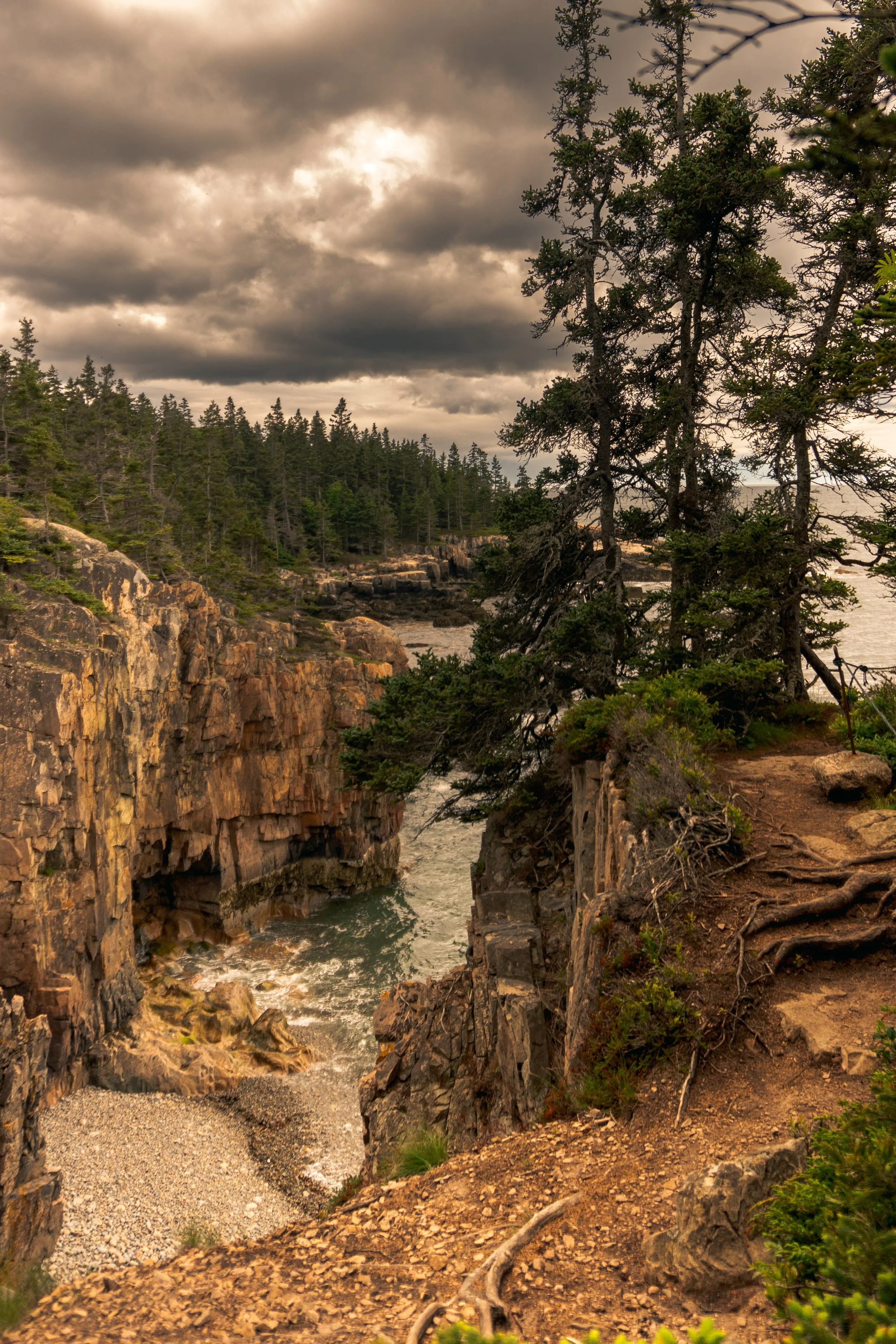
Without dramatic light to organize the photographs for me, composition had to become their architecture. I became much more conscious of how I was constructing each frame: not simply what I was photographing, but how line, shape, scale, tonal contrast, depth, and visual weight could tell the eye where to travel. I had to say goodbye to my good golden friend for the weekend.
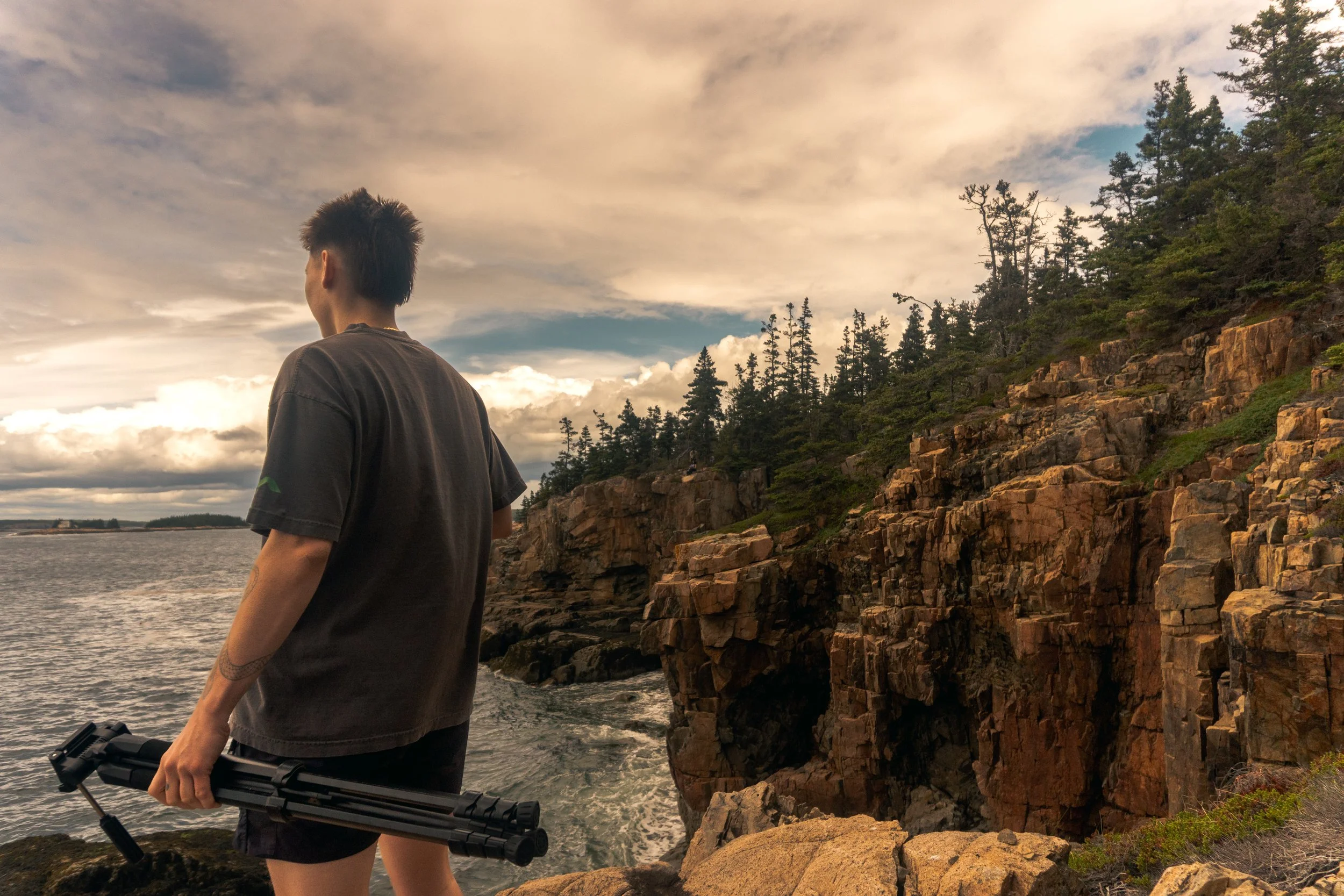
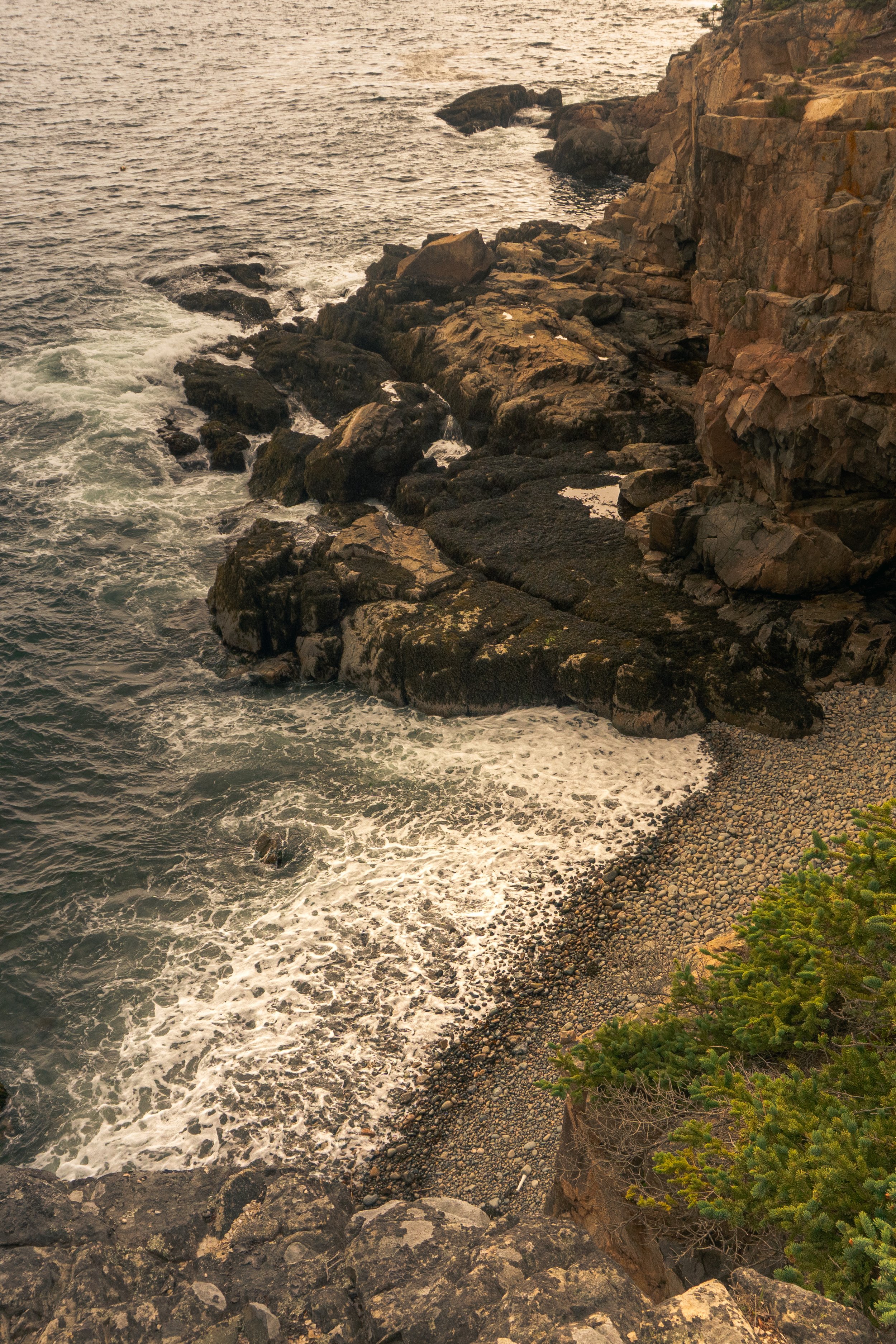
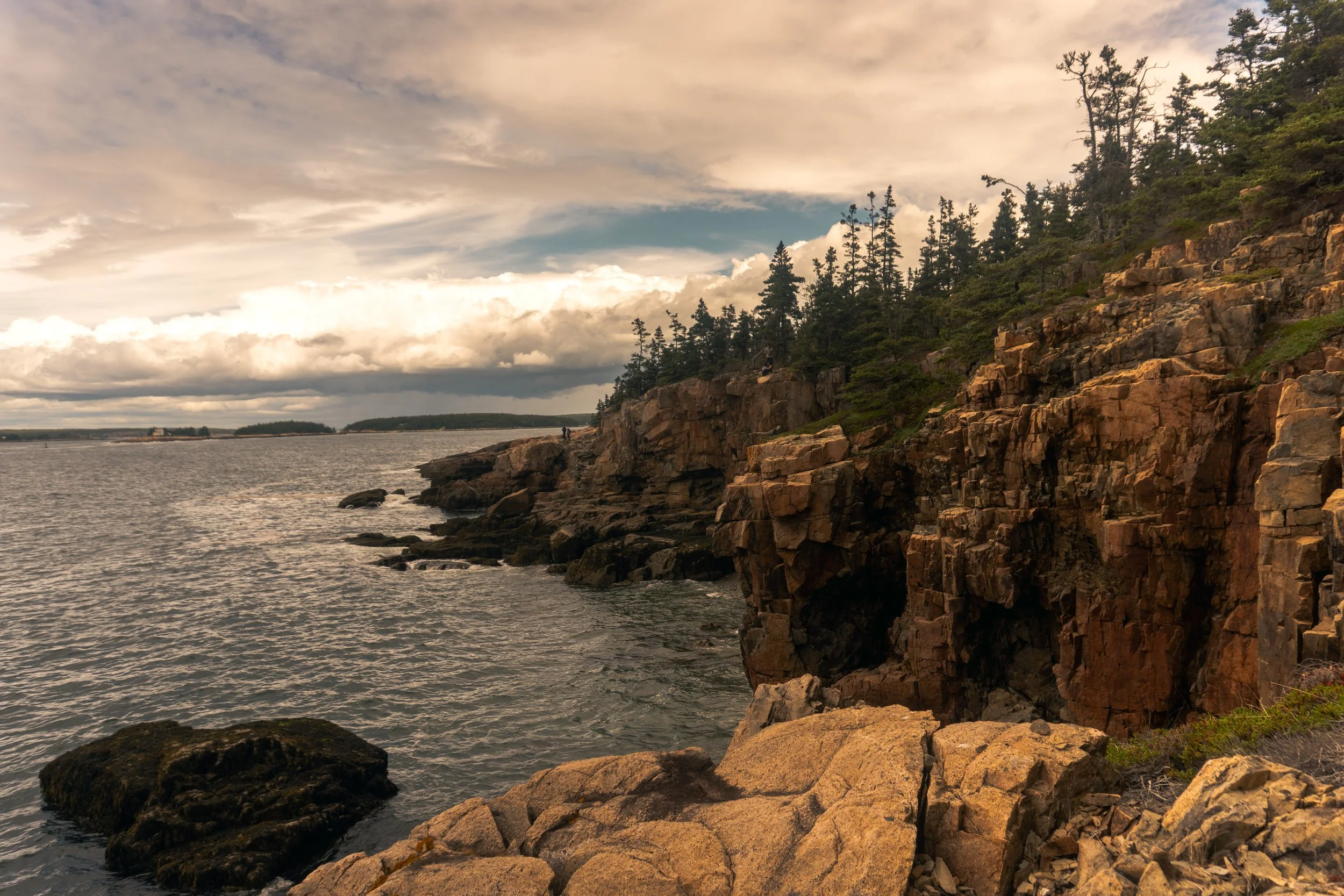
The coastline gave me an extraordinary amount to work with. Rather than treating the cliffs as scenery behind a subject, I used their contours as leading lines. The edges of rock naturally pull the eye deeper into the frame, often toward Anna or toward a distant point where land meets water. In several images, I positioned myself so that the shoreline moves diagonally rather than horizontally across the photograph. That diagonal creates movement; instead of allowing the eye to settle immediately, the composition carries it from foreground rock, along the coast, toward the figure and finally into the horizon.
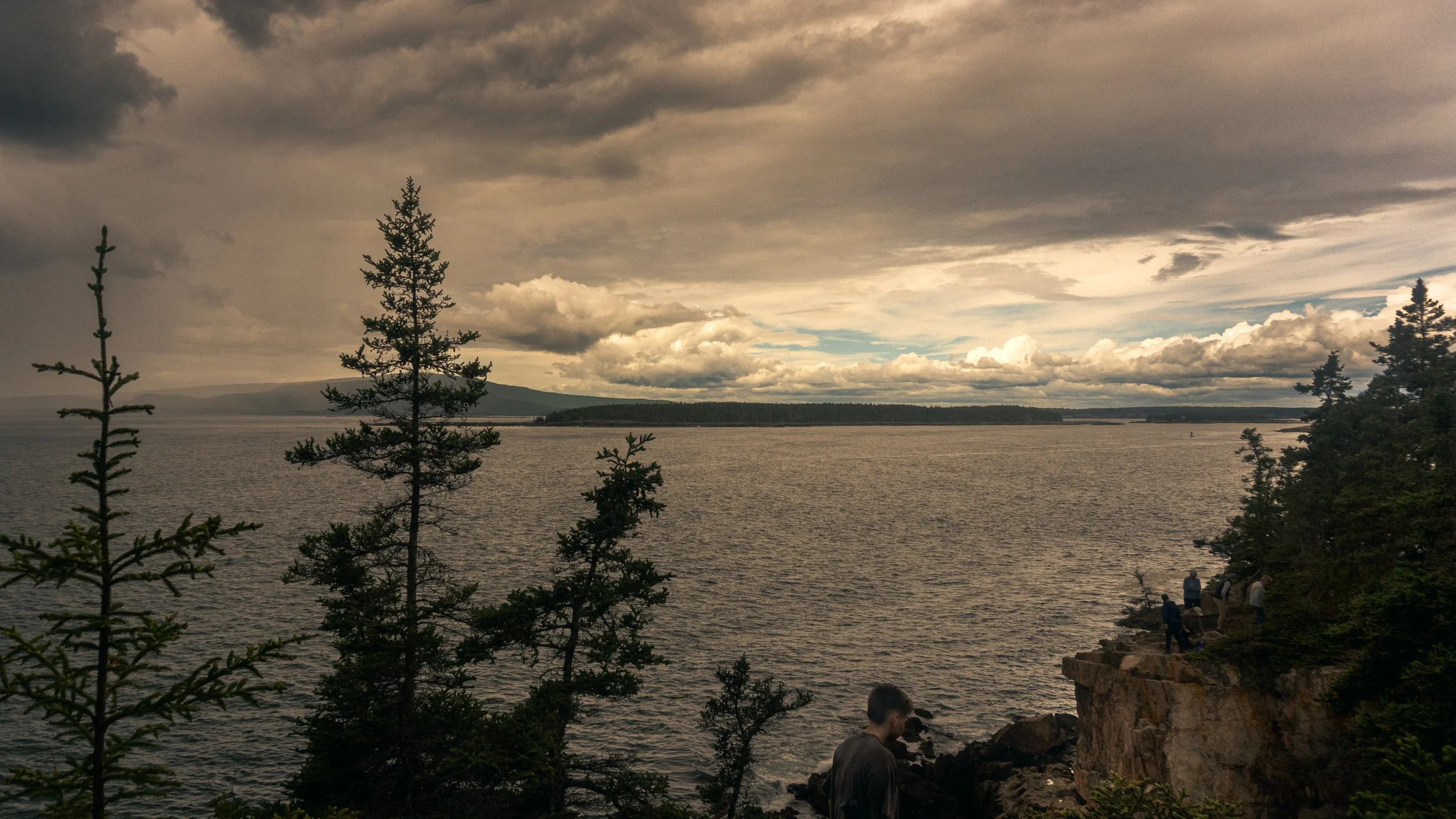
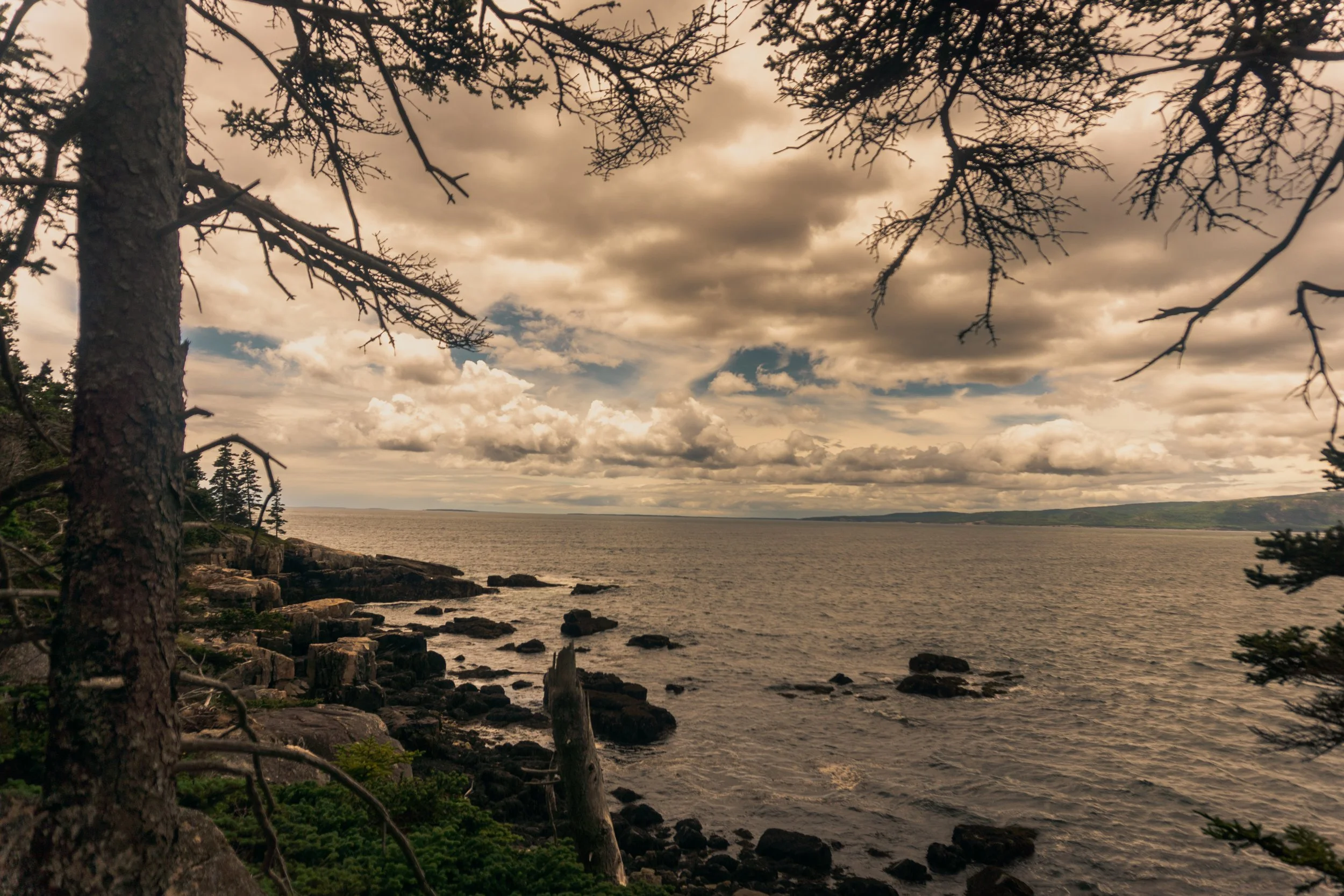
I also began using the landscape to create frames within the frame, something I often rely on in golden hour as well. Tree trunks, overhanging branches, openings between rocks, and the edges of cliffs became compositional boundaries. Photographing through them gave otherwise enormous landscapes a sense of enclosure and created distinct foreground, middle-ground, and background planes. A branch close to the lens establishes depth before the eye ever reaches the subject. Anna might occupy the middle distance, while the ocean and islands recede behind her. Instead of a photograph containing only a person and a landscape, it becomes a series of spatial layers. The layers aren’t separated by differences in aperture or lighting, but by the compositional elements within the photograph.
That layering became especially important under overcast light. When strong directional light isn’t creating depth through highlights and shadows, depth has to come from somewhere else. Overlapping forms became one of my tools: dark evergreen against lighter water, rock crossing rock, a human figure interrupting the horizon. Differences in scale and tone separate those layers even when the light itself is soft.
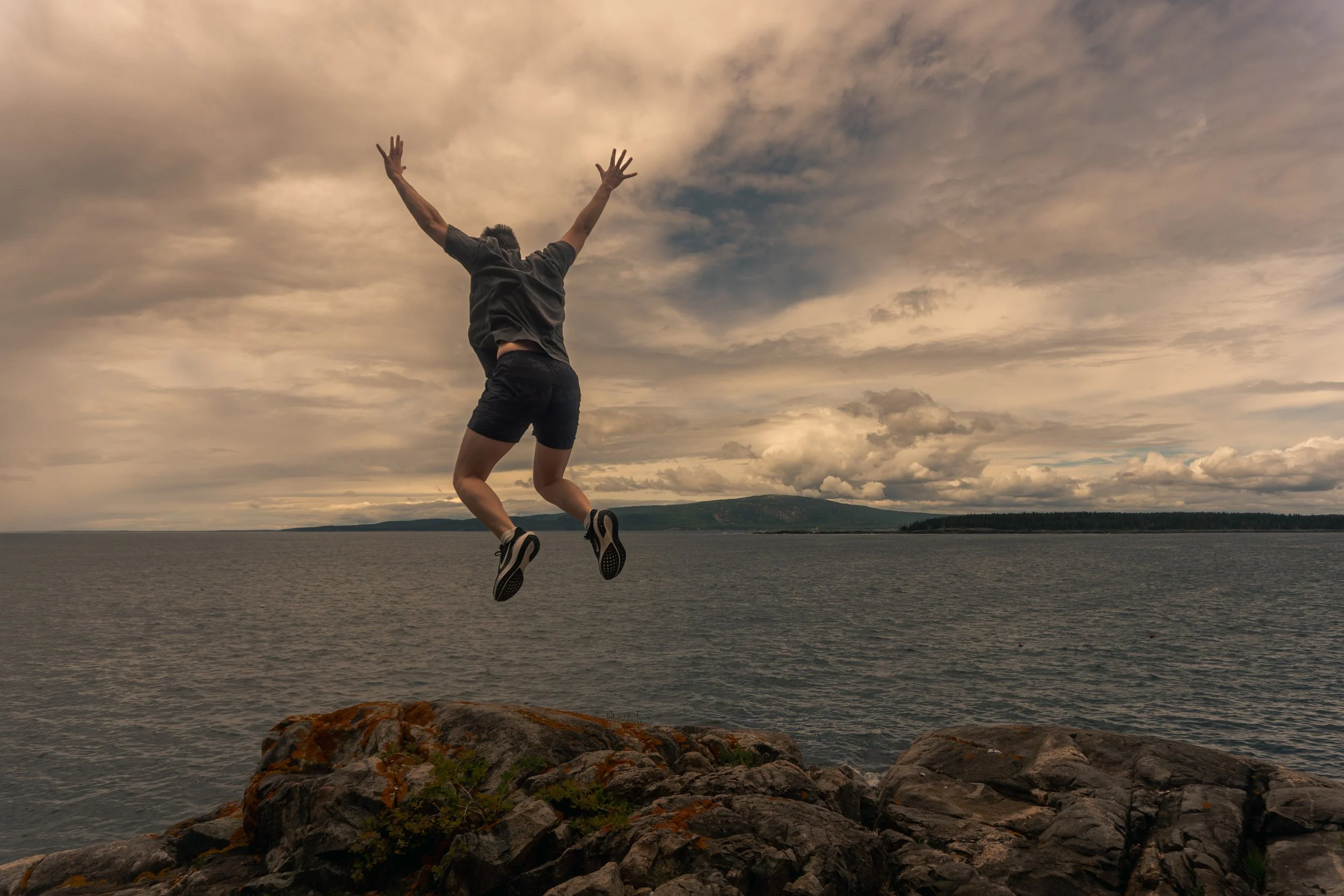
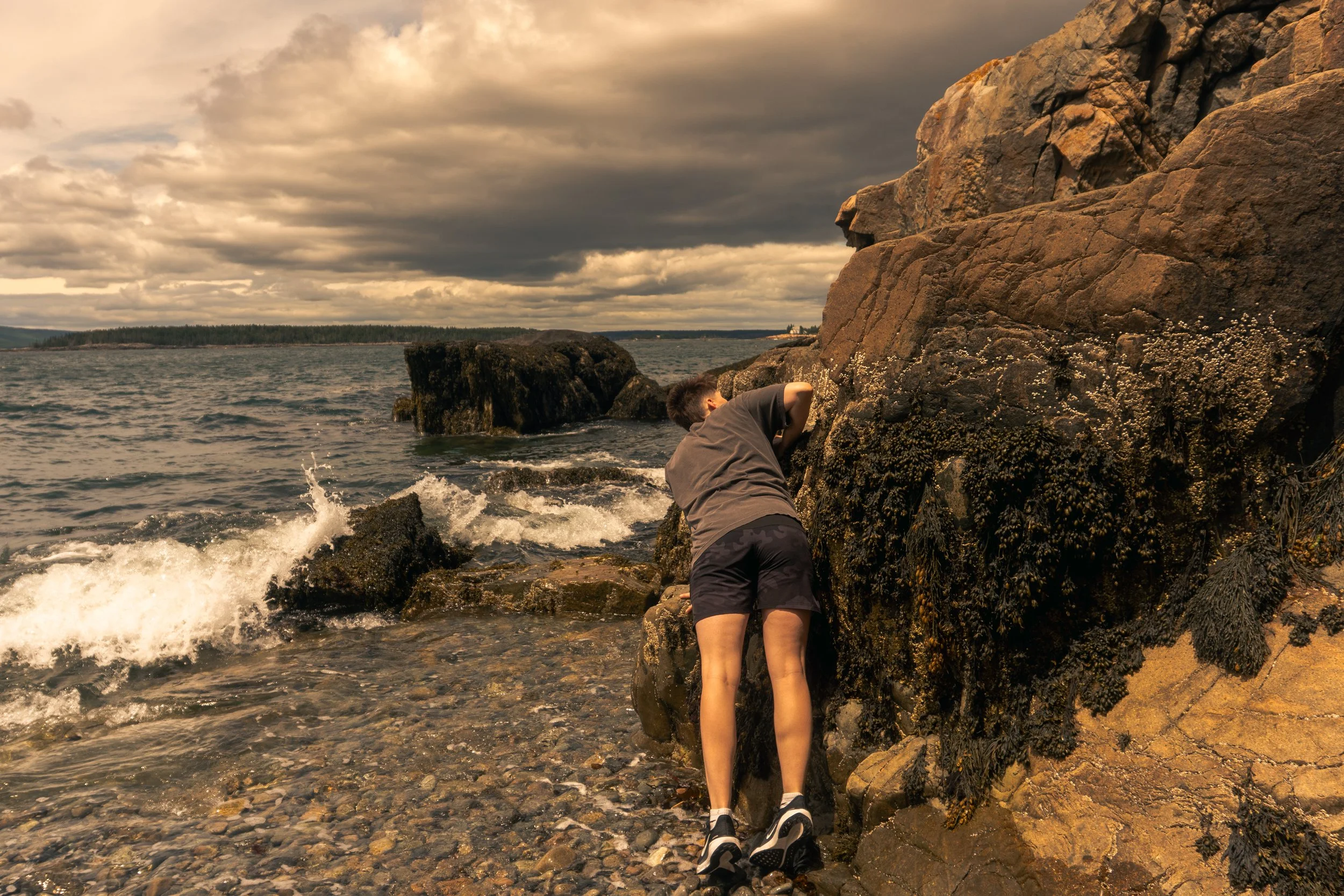
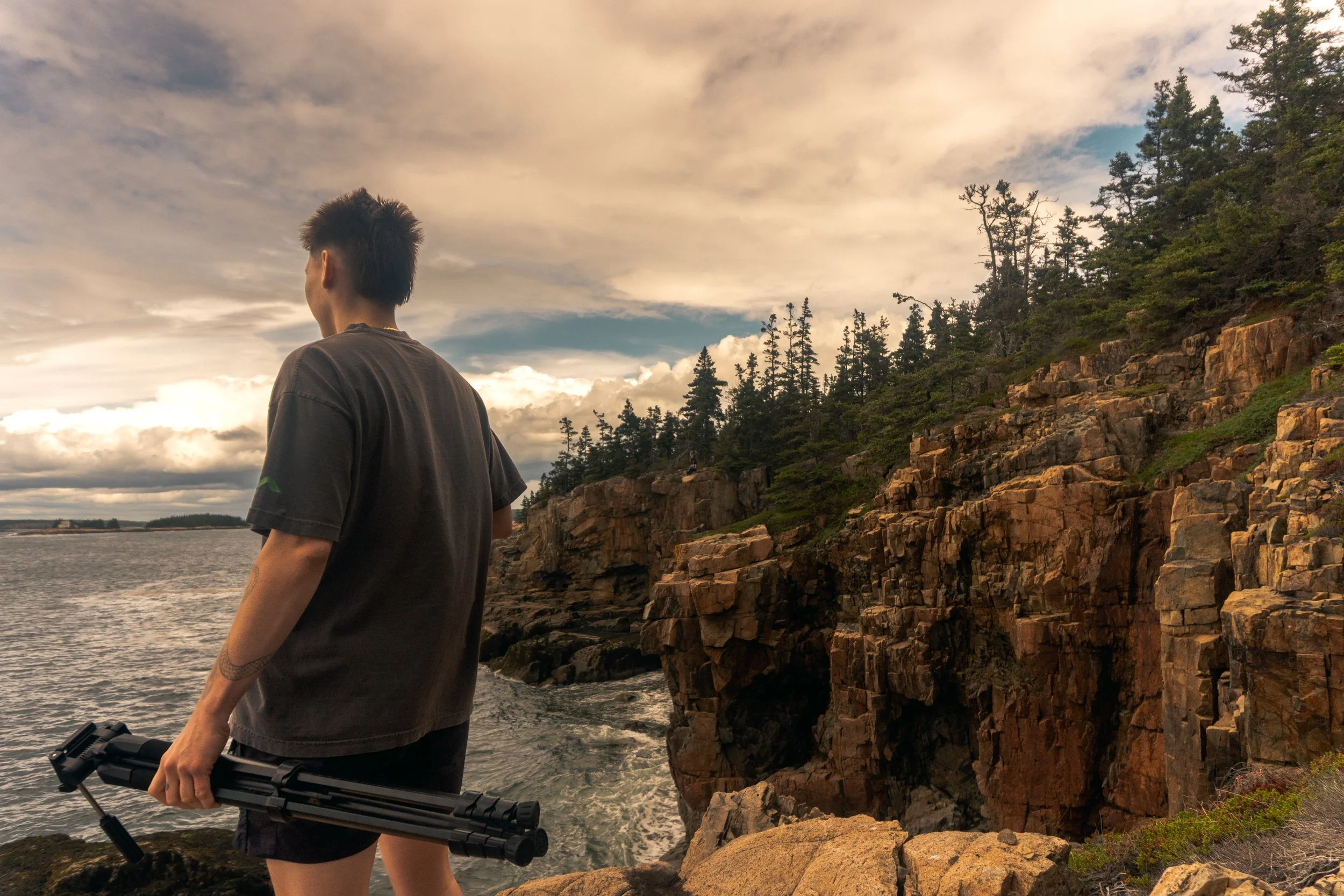
I became particularly interested in maintaining figure-ground relationships within the conditions I was shooting in. Anna is wearing dark, relatively simple clothing in many of these photographs, which gave me a strong graphic shape to work with. Against lighter ocean, sky, or stone, her silhouette remains readable even when she occupies very little of the frame. Rather than always bringing her closer, I deliberately allowed her to become small.
That decision changed the photographs from conventional portraits into environmental ones.
Scale became part of the story. When Anna is only a fraction of the frame, the viewer has to register the enormity of the cliffs and ocean before, or sometimes simultaneously with, registering her. Her smallness isn’t accidental; it establishes a relationship between body and landscape. A tighter crop could tell you what she looked like. The wider composition tells you something about what it felt like to stand there.
Negative space became equally useful. The open water and enormous stretches of cloud aren’t empty areas that needed to be filled; they give the more complicated sections of the frame somewhere to breathe. When one side of an image contains dense rock, trees, or a human figure, an expanse of relatively uninterrupted ocean can act as a counterweight. I started thinking about balance less as symmetry and more as the distribution of visual mass.
The horizons became intentional, too.
The rule of thirds is useful, but I don’t think a horizon belongs on a third simply because someone once taught us that it should. I started deciding its placement according to what was actually important in each scene. When the clouds were extraordinary, I lowered the horizon and allowed the sky to dominate. When the texture and geometry of the coastline mattered more, I gave the land the majority of the frame. In quieter seascapes, a more central horizon could create stillness rather than compositional laziness.
The question became: What deserves space?
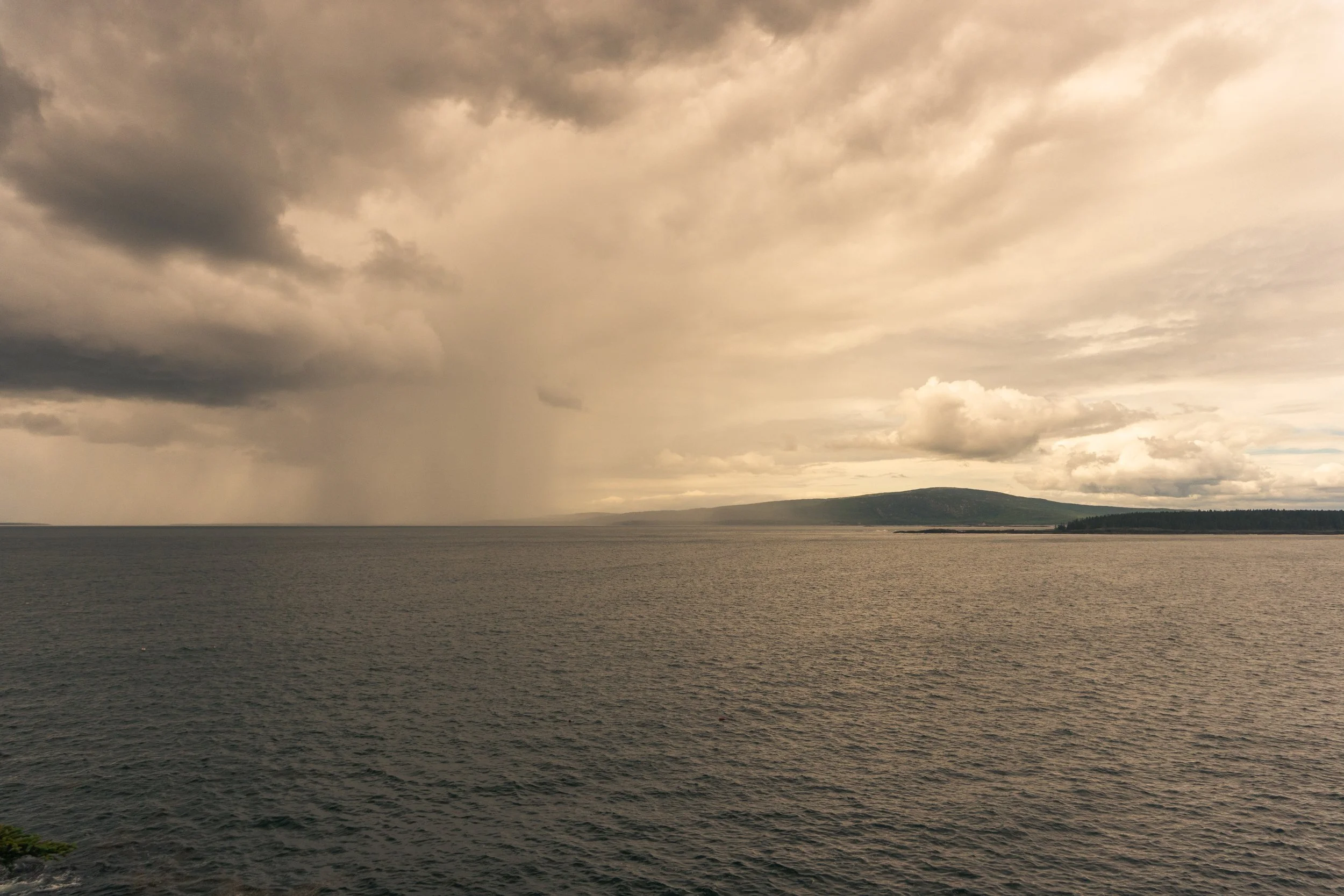
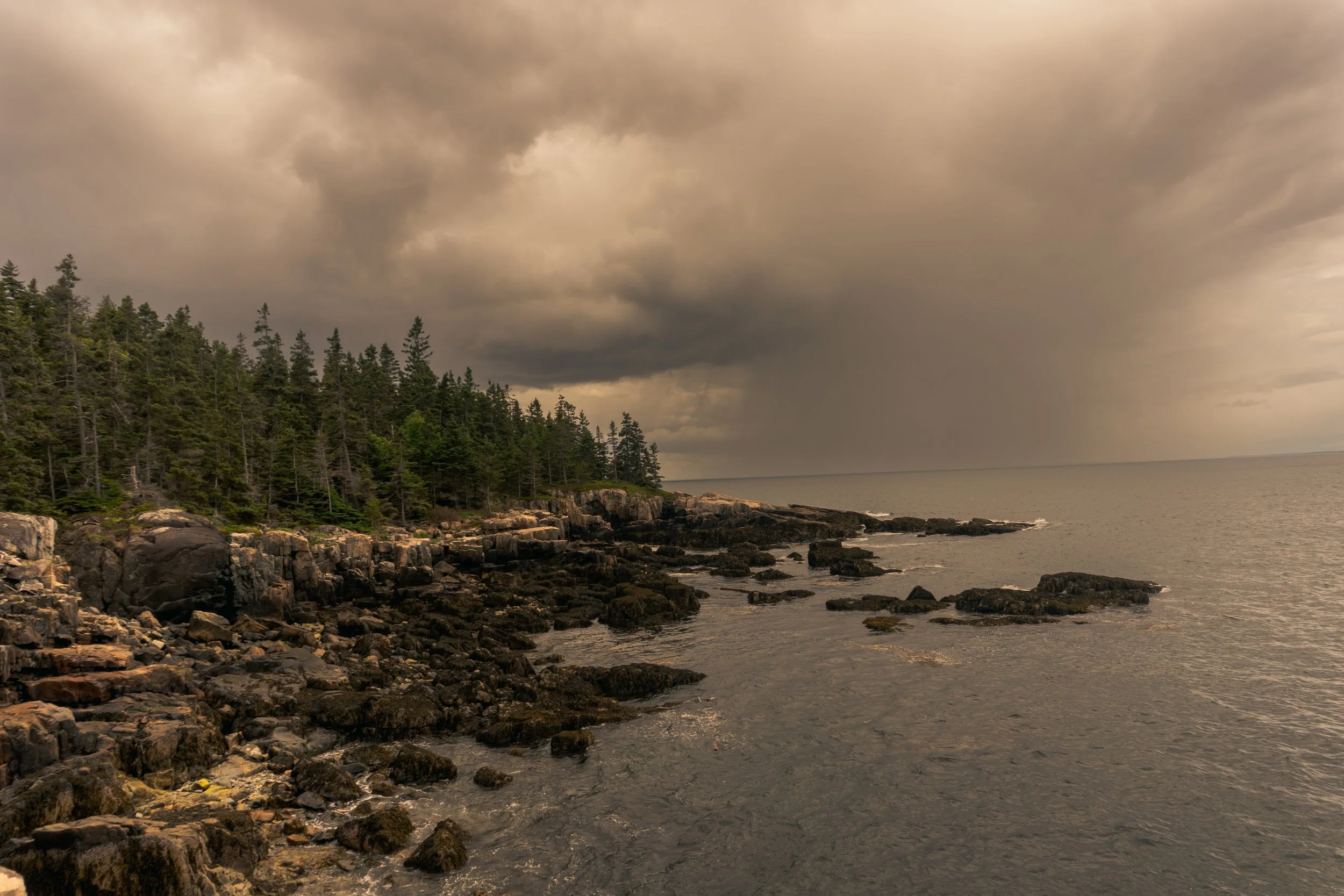
That question extended to the photographs of the storm itself. Rain was visibly falling across the water in the distance, creating a veil between the foreground and the land beyond it. Instead of treating that loss of clarity as something to correct, I used it as atmospheric perspective. Contrast and detail naturally diminish as elements recede through moisture in the air. Foreground rocks remain comparatively defined; distant islands soften; rain nearly dissolves the horizon. The atmosphere itself creates depth.
Acadia National Park, Schoodic Point
Overcast conditions also changed the technical relationship between exposure and mood. A camera’s meter wants to make the world approximately middle grey, but a grey day contains an enormous range of subtle tonal relationships that can disappear if the brightest portions of the clouds are allowed to clip. I wanted to retain information in those skies because the clouds were not an incidental background—they were one of my subjects. Preserving highlight detail allowed the folds, gradients, rain shafts, and brighter openings within the cloud cover to remain visible rather than collapsing into a blank white ceiling.
At the same time, I didn’t want lifting the shadows to eliminate the natural tonal hierarchy of the scene. The dark evergreens and rock faces needed to remain dark. Those areas give the photographs weight and provide contrast against the softer sky and water. The goal wasn’t to make every part of the histogram equally visible. It was to preserve enough dynamic range that I could decide deliberately where the photograph should feel heavy and where it should feel open.
Color worked differently, too. Rain deepens the apparent saturation of stone, soil, bark, and foliage, while the sky and water remain comparatively restrained. That created a natural warm-cool and saturated-muted relationship throughout the series: rust-colored granite and deep greens against grey-blue water and cloud. Instead of trying to force the scene toward the golden palette I normally love, I could let those quieter color relationships hold the photographs together.
Even the portraits required a different approach. Soft cloud cover functions like an enormous diffused light source, wrapping around a face rather than striking it from one direction. There are fewer hard-edged shadows to manage, but that doesn’t mean there is no direction to the light. I still watched for where the sky was brightest and positioned Anna relative to that opening. The difference is subtle, a gentle modeling across the face rather than a dramatic highlight-shadow transition, but subtle light is still light that can be shaped.
The more I photographed, the more I realized that overcast conditions weren’t removing tools from me. They were changing which tools mattered most.
I couldn’t depend on rim light to separate a subject, so I used tonal contrast.
I couldn’t depend on long shadows to create depth, so I used overlapping planes.
I couldn’t depend on a sunset to provide the focal point, so I used scale, leading lines, and figure placement.
I couldn’t rely on brilliant color to hold attention, so the geometry of the frame had to do more work.
And perhaps most importantly, I became much more willing to let the landscape remain complicated. Some of these photographs contain trees, cliffs, water, clouds, rocks and a human figure simultaneously. The solution wasn’t necessarily simplification. It was hierarchy. A complex frame can still feel deliberate when the eye understands where to enter, how to move through it, and where to stop.
That distinction, between complexity and clutter, has become increasingly important to me.
Looking back at the photographs, I can trace the paths my eye was making while I took them. A branch introduces the frame. A diagonal coastline carries me downward. Anna interrupts that line. The water opens beyond her. A distant island gives the eye one final place to land. That is composition to me: not placing objects according to a grid, but controlling the sequence in which a two-dimensional image is experienced.
Beautiful light can sometimes make us forgive a photograph whose structure isn’t particularly strong. A glowing sunset gives the eye an immediate reason to stay. Grey skies are less generous. When light and color become quieter, the bones of the photograph become easier to see.
So I had to keep asking myself:
Where does the eye enter?
What makes it stay?
Which line carries it somewhere else?
What is creating depth?
What is the visual weight of this person compared with this cliff?
Does this empty space need something in it, or is the emptiness the point?
What am I actually asking someone to look at?
Those questions made the rain feel less like a limitation and more like an exercise in seeing. Looking back now, I don’t wish the sun had come out! These photographs might have glowed. They might have contained the kind of golden light I know how to chase and will probably always love and perfer. But they would have been entirely different photographs, and I would not have been forced to grow as a photographer.
Instead, I have images constructed from layers of coastline, tiny human figures, dark evergreens, repeating rock formations, enormous stretches of negative space, rain dissolving distant islands, and horizons that sometimes nearly disappear into the weather.
The conditions didn’t give me the photographs I had imagined before arriving. They forced me to pay enough attention to construct photographs from what was actually there. I think that is one of the quiet disciplines of photography: learning to stop asking the world to become more photogenic for you.
Sometimes the sky stays grey.
The light never breaks.
And your job is to know what else makes a photograph work. :)